
London hides its best streets behind its biggest landmarks.
Ask anyone where to go and you’ll hear the same three names back: the Eye, the Bridge, Buckingham Palace.
Fair enough they’re worth the queue at least once.
But the version of the city that actually stuck with me wasn’t any of those.
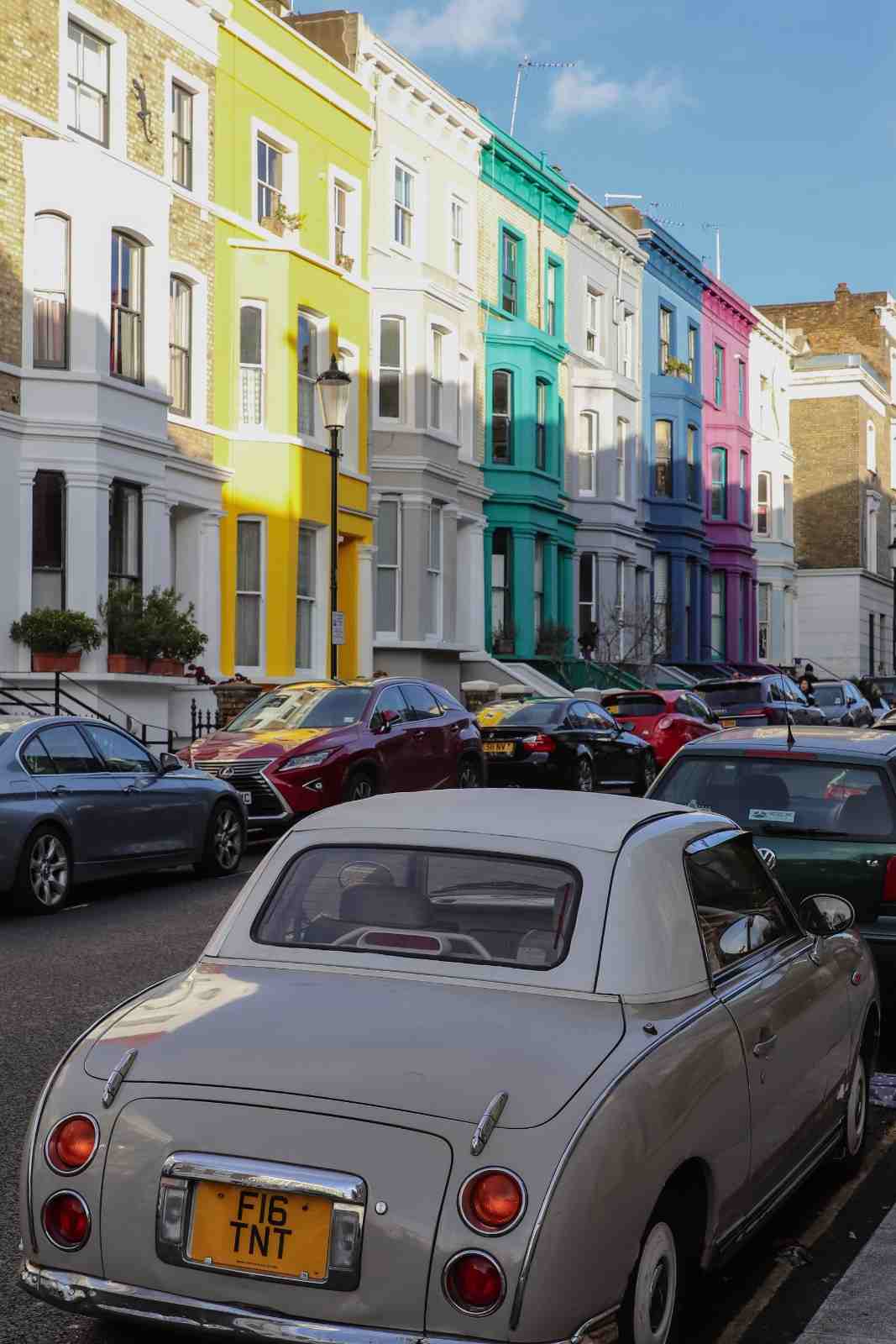
It was a curved row of Notting Hill townhouses I nearly walked past looking for a coffee shop.
A narrow Georgian passage near Covent Garden with gas lamps still lit at dusk.
A garden square in Bloomsbury quiet enough to hear your own footsteps.
None of them are secrets exactly, Londoners already know them but they rarely make it onto a first-timer’s list.
This is that list: ten streets worth slowing down for, and a route to actually see them in a day.
The Streets That Don’t Make the Postcards
Most first-time visitors build their whole itinerary around landmarks and hope charm turns up somewhere in the gaps between them.
It usually doesn’t work that way.
The prettiest corners of this city hide a couple of blocks off the obvious route — close enough to stumble into, easy enough to walk right by without meaning to.
Treating them as a reason to go out, rather than something to pass on the way to somewhere else, changed the whole rhythm of the trip.
That shift is really what this list is built around.
That pace change is what makes this particular list worth following, not just the ten streets themselves.
That pace change is what makes this particular list worth following, not just the ten streets themselves.
Portobello Road, Notting Hill
Portobello Road is the London street most people already half recognize, even before visiting.
Rows of candy colored houses line the road, and antique stalls spill onto the pavement every Saturday
Weekday mornings are quieter here.
You get the pastel townhouses without the market crowd pressing in from both sides.
Pair it with a slow coffee at one of the corner cafés.
That kind of stop turns a photo opportunity into an actual memory.
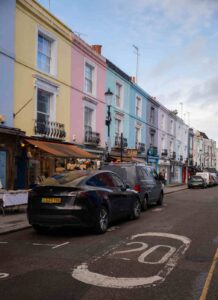
Of all ten streets on this list, it’s the one most people already half-recognize before they’ve even landed.
Best time to visit: weekday morning, before the Saturday antiques market fills the street.
Elgin Crescent, Notting Hill
Elgin Crescent is a quieter cousin to Portobello Road.
It has the same pastel charm without the crowds, curved rows of pink, cream, and pale blue houses framed by trees that arch gently over the pavement.
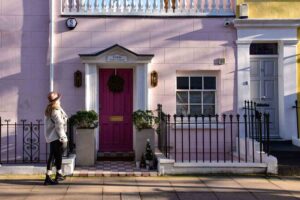
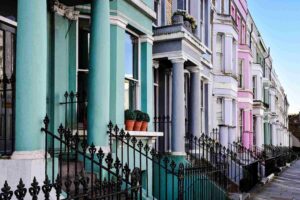
It photographs beautifully by accident, no perfect lighting or empty street required.
Worth seeking out even if Portobello Road already scratched the itch this one holds its own.
Best time to visit: any weekday afternoon, when the street is calm enough to actually notice the details.
Neal’s Yard, Covent Garden
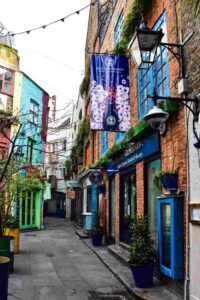
Tucked just off the busy paths of Covent Garden, Neal’s Yard feels like stepping through a doorway into somewhere completely different.
Every building front is painted a different shade. Window boxes overflow with flowers, and the noise of the city drops away almost instantly.
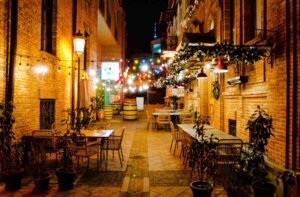
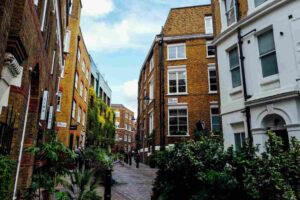
It is small and easy to miss.
Easy to miss if you’re not watching for the narrow entrance, and one of the better surprises on this whole route.
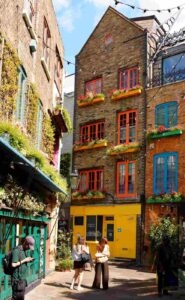
Best time to visit: midweek, midday, when the small courtyard has room to breathe.
Shad Thames, Near Tower Bridge
Shad Thames is a cobbled riverside lane lined with old Victorian warehouses.
Original walkways and iron bridges still cross overhead between buildings.
It sits just behind Tower Bridge, close enough to combine both in a single walk.
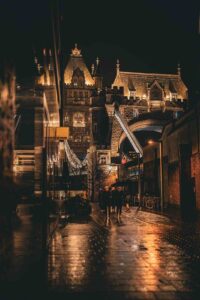
There is a quiet industrial beauty here that feels completely different from the pastel streets further west.
It’s proof this route isn’t chasing a single look pastel townhouses aren’t the only kind of pretty London does well.
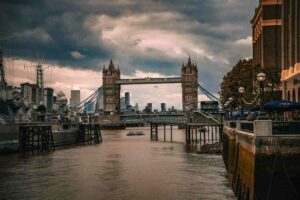
Best time to visit: golden hour, when the warm light catches the old brickwork.
Gordon Square, Bloomsbury
Bloomsbury’s garden squares get skipped by most visitors entirely, which is exactly why this one is worth the detour.
Gordon Square is one of the loveliest, framed by Georgian townhouses and tall plane trees.
It carries a literary hush to it.
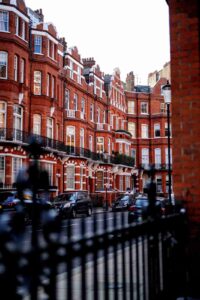
This was Virginia Woolf’s old neighbourhood, and it still feels like the kind of street where nothing needs to be rushed.
Best time to visit: early evening, when the square empties out and the light turns soft.
Camden Passage, Islington
Not to be confused with Camden Market, Camden Passage is a narrow pedestrian lane in Islington.
Antique shops, small bookstores, and cafés line the converted Georgian storefronts.
It has a village feel that is easy to forget still exists inside London.
The traffic noise fades away just a few steps in most visitors never even hear about this one, which is exactly the appeal.
Best time to visit: weekend mornings, when the antiques stalls set up along the lane.
Cheyne Walk, Chelsea
Running along the Thames in Chelsea, Cheyne Walk is lined with grand Georgian and Queen Anne townhouses.
Many carry blue heritage plaques marking the artists and writers who once lived behind those doors.
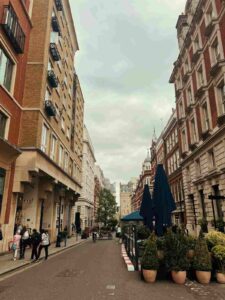
It’s the quietest, most residential stop on this route better suited to an unhurried walk than a five-minute photo stop.
Best time to visit: late afternoon, paired with a walk along the Chelsea Embankment.
Goodwins Court, Covent Garden
Barely wider than a hallway, Goodwins Court is a narrow Georgian passage with bow fronted windows and old gas lamps that still light up in the evening.
People often describe it as the closest London gets to a real life Diagon Alley, and walking through it after dark makes that comparison feel earned.
Once the lamps are lit, it’s arguably the most atmospheric street on the entire route.
Best time to visit: early evening, once the lamps are lit and the passage empties out.
Trinity Hospital Almshouses, Greenwich
A little further from central London, this quiet row of almshouses near Greenwich Park offers a different kind of pretty. Weathered brick and neat gardens create a stillness that feels far removed from the pace of the city centre.
Combine it with a walk through Greenwich Park.
Paired with the park next door, it makes for one of the most peaceful afternoons on this whole route.
Best time to visit: a clear afternoon, ideally paired with the park nearby.
Bedford Square, Bloomsbury
Bedford Square is the most complete Georgian square left in Bloomsbury, ringed by uniform townhouses and a private garden at its centre.
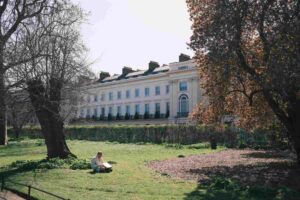
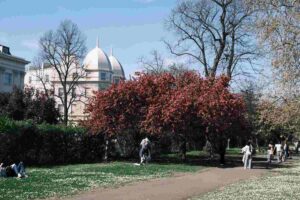
Its formal, storybook symmetry earns it a spot here without a single shop or café along it.
Best time to visit: mid morning, when the light falls evenly across the terrace.
Tips for Walking London’s Prettiest Streets Like a Local
Wear shoes built for cobblestones and uneven pavement Shad Thames and Camden Passage in particular are not flat.
Portobello Road and Neal’s Yard, the two busiest stops on this list, fill up fast once the day gets going.
A full day gives you more room than a single afternoon.
Build the route by neighborhood rather than trying to hit all ten streets in one sweep across the city.
Pacing by neighborhood makes the biggest difference.
It’s what turns this from a checklist into an actual day out, rather than a scavenger hunt across the city.
This shorter route strings together four of the most rewarding stops for visitors without a full day to spare.
How to Plan a Full Day Around London’s Prettiest Streets
A full day gives you more room than a single afternoon. Build the route by neighborhood rather than trying to hit all ten streets in one sweep across the city.
Start west in Notting Hill early, before Portobello Road fills up and the crowds catch on.
Work your way through Elgin Crescent while the pace is still calm.
Head east toward Covent Garden for Neal’s Yard and Goodwins Court around midday.
Spend the afternoon in Bloomsbury. Gordon Square and Bedford Square offer a quieter, more residential contrast to the busier stops earlier in the day.
Finish along the river at Shad Thames or Cheyne Walk if you have energy left, timed for that late afternoon light that makes both streets look their best.
Pacing by neighborhood makes the biggest difference. It’s what turns this from a checklist into an actual day out, rather than a scavenger hunt across the city.
A Half-Day Route for London’s Prettiest Streets
This shorter route strings together four of the most rewarding stops for visitors without a full day to spare.
Start at Portobello Road for a morning coffee and a slow browse through Notting Hill. Walk south toward Neal’s Yard for its hidden courtyard colour.
Continue to Goodwins Court nearby for its quiet Georgian charm. Finish along Cheyne Walk in Chelsea, ideally timed for late afternoon light over the Thames.
FAQ
Which of these ten streets should I see if I only have time for one?
Portobello Road, hands down it’s the most photographed for a reason, with rows of pastel townhouses and a Saturday antiques market. Elgin Crescent next door offers nearly the same charm with a fraction of the crowd.
Do any of these streets charge admission?
No. Every stop on this list is a public street, passage, or square, free to walk at any hour.
When is the best time of year to visit?
Late spring through early autumn gives the most reliable light and the fullest window boxes, especially around Notting Hill.
Is Notting Hill safe for a walking visit?
Yes it’s a well-established residential neighborhood, comfortable to walk through during the day and early evening, particularly around Portobello Road.
Final Thought:
The big landmarks earn their reputation, and they’re worth seeing at least once.
But London’s real character tends to show up somewhere quieter: a curved row of townhouses, a lamplit passage, a square you’d walk straight past if you weren’t looking for it.
Build a little unhurried walking time into the trip.
These ten streets are the ones worth coming back for, long after the landmark photos have blurred together.
Discover more from Escape Cents
Subscribe to get the latest posts sent to your email.